2 Fluid and crystalline intelligence
Somewhere in the middle of the last century the psychologist Raymond Cattell drew a line through intelligence that psychology still uses. On one side he put fluid intelligence: the capacity to reason about a problem you’ve never seen, to spot the pattern in the noise, to hold six things in your head and work out how they fit. On the other he put crystallized intelligence, everything that learning has deposited: vocabulary, facts, rules of thumb, the judgment that experience already paid for. Fluid is what you bring to a puzzle. Crystallized is what you bring to your job. The book borrows that line and nothing else from him: Cattell also spent decades arguing for eugenics, which I reject, and the preface says so in my own words. The idea long ago outgrew him; John Horn developed it with him, and it lives on in today’s models of intelligence.
Fluid and crystallized intelligence age differently, which is how the seam was noticed. Fluid intelligence peaks early and drifts down for the rest of a life. Crystallized intelligence keeps climbing long after fluid has peaked, because it’s fed by living. An eighty-year-old surgeon is slower at a logic puzzle than she was at twenty-five, and vastly better at surgery and nobody finds that paradoxical. The puzzle is fluid. The surgery is what forty years deposited.
2.1 A graduate who knows everything
A large language model is fluid intelligence in its purest form. It arrives the way a very good graduate arrives on their first day: broadly, almost absurdly educated. It has read the textbooks, the standard library, half the internet’s arguments about tabs and spaces. Pretraining is the education, and it’s the entire library. But everything in that library is general. The graduate knows what a retry queue is in the way a graduate knows what a company is: as a concept, correctly, with no idea what yours is called.
Ask the graduate about your company and you get an intelligent guess assembled from the general case: as far as your company is concerned, the model is all fluid, capable of everything and told nothing. It reasons brilliantly about whatever is in front of it, in the moment, and the moment is all it has. When the session ends the reasoning is gone, the decisions are gone, the thing you explained at four in the afternoon is gone. Tomorrow the graduate walks in again: first day, same suit.
None of that is a flaw in the model, any more than it’s a flaw in the graduate. Nobody expects a new hire to arrive knowing the team’s conventions. We expect them to learn, and the learning is the part a model can’t do on its own. It has no place to put what it learned.
2.2 The other half
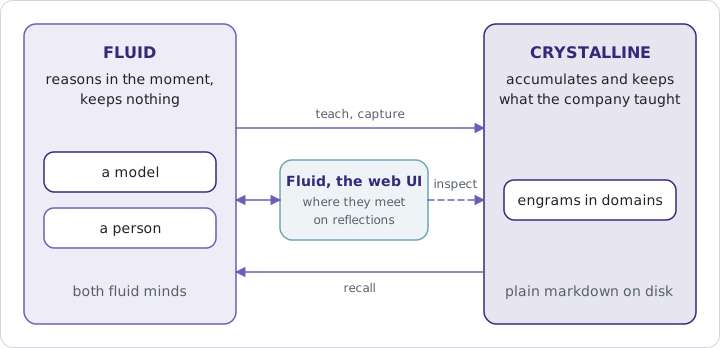
Crystalline is the other half: the crystallized intelligence an agent accumulates and keeps. The agent is onboarded at the start of a session with a briefing on where knowledge lives, is taught what matters and captures what it learns as engrams while it works. Session by session, the same fluid mind stops arriving as a stranger, because there’s now a body of what-the-company-taught standing beside it, and it reads from that body before it reasons.
The split maps cleanly onto the new hire. What the model arrived with is the degree: general, portable, the same for every employer. What Crystalline holds is what the company taught: the specific, the local, the thing you’d put on the onboarding slide if you ever had time to make one. The degree is why you hired them. The onboarding is why they’re useful by month two. Neither half does the job alone, and the surgeon is the proof: fluid intelligence with nothing deposited is a brilliant first day forever, and deposited knowledge with nothing to reason over it is a filing cabinet.
Notice which side the humans are on. You’re fluid too. So is everyone on your team. Human beings carry their crystallized half around inside their own heads, which is convenient and also the reason companies lose so much when someone leaves. Wiki pages, slide decks and the diagram on the whiteboard are all attempts to get some of that deposit out of heads and into something people share. Crystalline makes the same move for the agent: a crystallized half of its own, which it writes itself, in a format built for it to act on.
The bookseller at Capsule Corp Books learned you over a year. Three visits in, she stopped showing you the nine-hundred-page epics. By the fourth she had a paperback put aside, because you’d once said you liked a book that opens with a joke and ends with an idea, and she’d remembered. Nobody calls any of that unusual. It’s how a person becomes useful.
Your agent gets the same year in an afternoon. You tell it the same things in a session, one at a time, and it captures each into books as you go. You pair with it on choosing the holiday stack, and at the end of the session it proposes capturing what it noticed: that you put two books back for being over four hundred pages, that the one you kept was a Tessier-Ashpool paperback. A week later you ask it for a maintenance sweep, and the note you typed into Fluid yourself one evening comes up as an unreviewed human capture; the agent verifies it, aligns its tags and wires it into the graph. The bookseller and the agent learned you the same way, by watching what you kept. Only one of them will still have all of it in a year, word for word, with the date each thing was learned.
2.3 Why the web UI is called Fluid
The name has nothing to do with liquids. It comes from the minds that meet there, and every one of them is fluid: yours, your colleagues’ and the model’s, inside the agent. The agent doesn’t need the UI for its crystalline half: it captures and recalls its engrams on its own, through its tools.
Chapter 1 drew the whole picture (Section 1.2): the agent presents what it knows on a topic in a document for people, called a reflection, and people put it to the test. People and the agent meet over reflections. In Fluid you open the reflection, change the line that’s wrong and comment where something is missing. The agent reads what you changed and opens a thread when it doesn’t agree. You and the agent are working on the same page, and if you’ve ever watched Spock put his hand on somebody’s face, you have the picture: two minds, one body of knowledge, for as long as the contact lasts.
When something looks off, Fluid lets you in through a side door to the engrams, so you can fix the one fact the agent got wrong. Fluid is deliberately not a second knowledge base. It has no store of its own. It shows the same engrams the agent reads, over the same daemon, on the same port, and what you fix there is the same file on disk the agent searches in its next session. There’s one truth, and the agent keeps it.
2.4 What the framing changes
A framing is only worth having if it changes what you do on a Tuesday, so here’s what this one changes.
You teach rather than file. Nobody organizes a colleague. You tell them things, in the order they come up, and you trust them to put what you said where it belongs. That’s how knowledge enters Crystalline: you say “remember that the cutoff is a day, and why”, the agent proposes an engram in the fitting domain, you say yes. The category, the tags and the domain are the agent’s job, checked by you the way you’d glance at a new hire’s first commit.
You correct rather than rewrite. When a colleague has a fact wrong you don’t rebuild their understanding from scratch; you say “it runs from first failure, not enqueue”, and they update the one thing. In Crystalline a correction is an edit in place, a changed value where it stands. When the world itself changes (the old fact was true and now isn’t), the old fact is retired with a date on it rather than deleted. A colleague who has forgotten why the team stopped doing something is a colleague about to do it again. Chapter 3 walks that loop; chapter 10 makes it a practice.
You decide what to write down by asking one question: would I tell a new hire this? The chargeback rule behind the retry cutoff: yes. The fact that the queue is called the sin bin: yes, because otherwise you’ll explain it every time. The contents of yesterday’s stand-up: no. The whole of the vendor’s forty-screen recall notice: no; the two paragraphs that affect you: yes, with a link back. Crystallized intelligence is what learning deposited, not everything that ever passed through the room. Distilling is the skill, and you already have it, because you already onboard people.
And you stop treating the agent as a lookup service. You teach a colleague so you can hand them the task and go do something else, and the same is true here. Once the agent carries the crystallized half it can act on it: search the domain, recall the cutoff, write the function in Python and tell you what it found on the way. Part III is about that handoff.
A model is the smartest colleague you’ll ever have for exactly one conversation. Everything in this book is about the second one.
Psychology splits intelligence into fluid, which reasons about the new in the moment, and crystallized, which is what learning deposited. A language model is fluid intelligence: a graduate who knows everything in general and nothing about your company, and forgets the day at the end of it. Crystalline is the other half, what an agent accumulates and keeps. Fluid, the web UI, is named for the fluid minds, human and model, that meet there on reflections, with a side door into the engrams. The framing changes the verbs: you teach and correct rather than file and organize, you write down what you’d tell a new hire and you hand over tasks rather than look things up.